Applying NASA's satellite-imaging trick to ancient museum objects
October 9, 2026
Middle coffin of Pestjenfi. Priest of Amun at Karnak. Painted wood with glass-inlaid eyes, 26th Dynasty, Thebes. The museum's record mentions only scattered traces of red paint on the body. The stretch shows a line marking a hairline, with yellow/gold above it that isn't in the record. Ägyptisches Museum und Papyrussammlung, Berlin.
I first heard about DStretch in a Hacker News thread on NASA's write-up of it. It's a little plugin that rock-art researchers use to see paintings on cave walls which have faded almost to nothing. Jon Harman wrote it in 2005, and it's built on a trick from 1970s satellite imaging called decorrelation stretch.
The trick works like this. In photographs the RGB channels are highly correlated, because most of what varies across the picture is the big swings in lightness, like shading or how light or dark each surface is. The stretch rotates the colours onto new axes that aren't correlated, stretches each axis so they all have the same spread, then rotates them back to an approximation of the original. The differences in color are much smaller than the differences in lightness, so they get stretched the most, and colours that were nearly the same come out wildly different: a bit of red ochre that looked like vageluy warmer rock ends up hot pink. Very different results than you would get playing with levels or contrast in Photoshop.
The colours you get aren't true to life, although it's fun to imagine that ancient Egypt was actually quite vaporwave in aesthetic. Since the stretch exaggerates each colour's difference from the photo's average colour, hot pink means "redder than the rest of the picture", not "neon paint". Harman notes that the colours can be radically different from the original, and each image enhances differently, depending on its own distribution of colours, so the same paint can come out a different colour in another photo.
Since museums now give away big free high-res photographs of their collections, and a lot of ancient objects were once painted/inlaid with colour that has faded or disappeared under a few thousand years of dirt, I wanted to know what DStretch would do with them. I couldn't find anyone else who had done this kind of processing of museum artifacts or collections, although it seems very common for archaeologists to use in the field on rock art and tomb/temple walls.
How it worked
I pulled about 4,600 colour photographs of 2,400 objects from the Met, the British Museum, the Cleveland Museum of Art, the state museums in Berlin, and Wikimedia Commons. Every one ran through Harman's DStretch plugin in three of its colour modes. I looked at every processed photo set next to the original photo and flagged the ones that looked interesting.
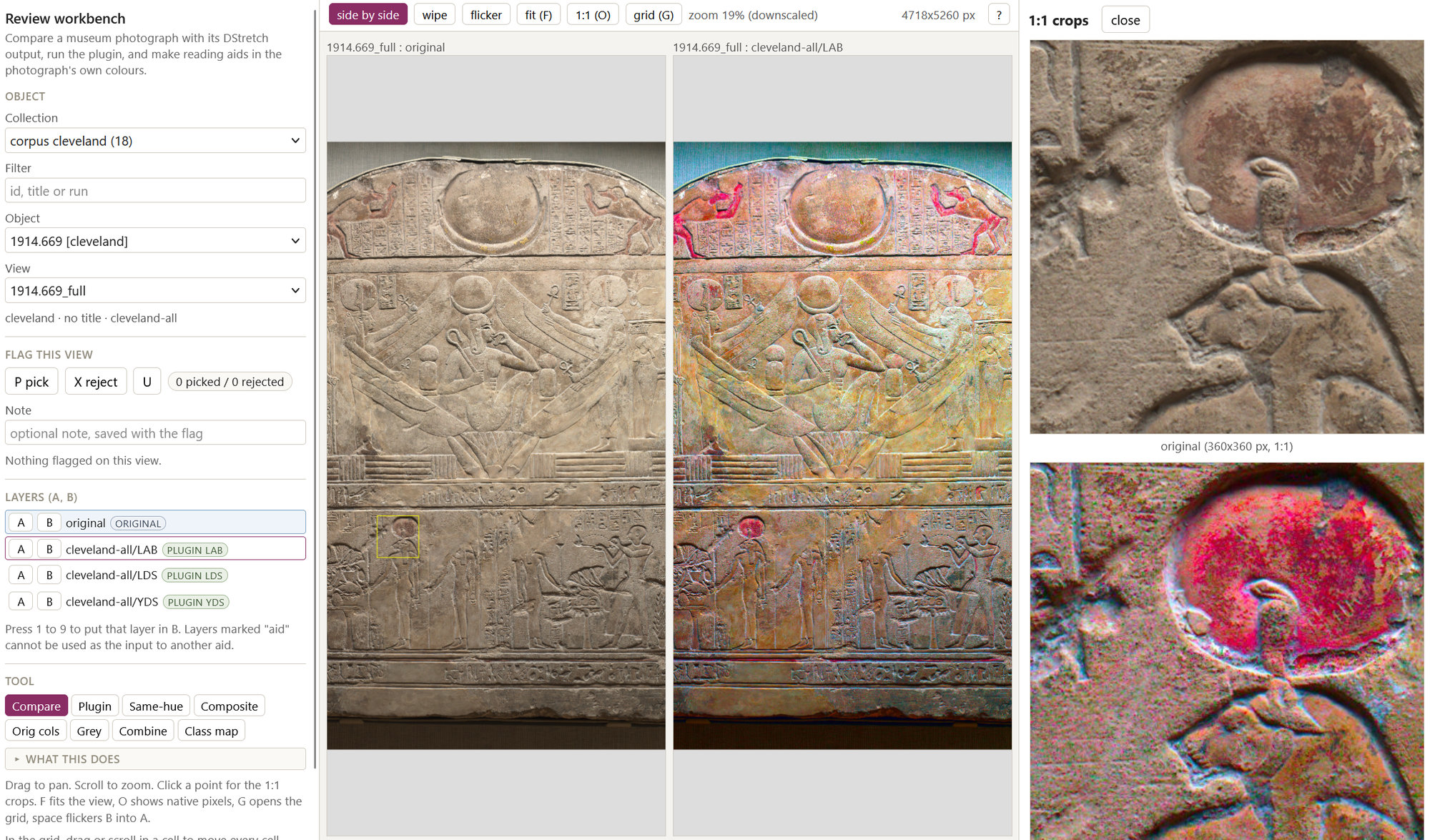
Anything that looked like it had something going on when stretched got a full workup with all 22 of the plugin's colour modes, and the best settings tried on any other photos of the same object. To help with processing, I built a review dashboard using Claude Code that acted as a poor man's Lightroom. It let me choose between the different colour modes in a 1:1 comparison view, and zoom/pan/flag easily. Claude also built the scripting that downloaded all the photos and fed them to ImageJ/DStretch, and drafted the initial captions for each photo on this page.
The review dashboard. Stele of the High Priest of Ptah, Shedsunefertem, limestone, originally painted and gilded, Dynasty 22. The original beside the plugin's LAB stretch, with 1:1 crops of one sun disc. Cleveland Museum of Art.
Usually, when I found something and then went back to the original photo at full size, I could see the faint traces of color, but sometimes it was invisible in the original. A lot of high-profile museum objects undergo technical photography of course, and while I am not an expert, I assume UV/infrared/fluorescence/raking-light photography would probably reveal a lot of the same stuff that we're seeing here. But the nice thing about DStretch is you don't need to go back to the item, you just need a good photo.
There is a risk of false positives. If you look at the Shemai stele, every third rib of the curved cornice along the top comes up green, which I can't see in the original at all and I was a bit worried was a compression artifact. I found other photos from the museum of it to run DStretch against, and it comes up the same way on those photographs under different lighting, which confirms it's not something the stretch invented. DStretch does respond to distance/material which means you do get false positives, and here were a handful of other objects where I didn't get the same results in a second photo, so those didn't make it onto the collection you see here. It works best on flat painted surfaces and on separate materials set into cells. Smooth, rounded statues under studio lights sometimes come out with convincing nonsense colours, the lit side and the shadow side splitting into two colours that look a lot like paint.
Most artifacts didn't show anything. But a few of them had wild results. Each of these below is the museum's own photo at full resolution with the stretched version laid over it. Scroll or pinch to zoom, drag to look around, and slide to wipe between the photo and the stretch. Results are sorted by artifact material.
Painted wood
Post coffin of the sisters Sensaos and Tkauthi. Painted wood, 2nd century AD, El Khokha, Thebes. Daughters of Pollius Soter, who died aged four and not quite three. The catalogue describes a striped dress and a second, cloak-like garment patterned with dots and circles. The dots come up magenta, and the same settings pick out the same parts on the coffin's other photographs. Ägyptisches Museum und Papyrussammlung, Berlin.Sacred cobra (uraeus) with sun disc. Painted and partly gilded wood, 13.5 cm, Third Intermediate Period, Thebes-West. The painted cobra on the front is barely there in the photograph and neon in the stretch. Ägyptisches Museum und Papyrussammlung, Berlin.
Painted stone
Stele of Shemai. Painted limestone, Middle Kingdom, Qubbet el-Hawa (Aswan). Chief of police. Shemai's skin comes up magenta and stops at his wig, which goes green, the offering loaves are magenta too, and the hieroglyphs come apart into different colours. Every third rib of the cornice along the top comes up green, which I can't see in the photograph, and it does the same on the museum's second photograph. Egyptian cornices were painted in repeating bands of colour, which is what this looks like. Cleveland Museum of Art.Ostracon with a king at the window of appearances. Painted limestone flake, 19th–20th Dynasty, probably Deir el-Medina. The catalogue says the drawing is in black over red sketch lines. The stretch splits the two kinds of line. Ägyptisches Museum und Papyrussammlung, Berlin.Stele of Hori, scribe of the pharaoh. Painted limestone, 100 cm high, reign of Ramesses VIII, Abydos. The catalogue says the god Onuris-Horus stands apart from the others in a yellow garment and a yellow feathered crown, and his garment and crown come out as their own colour. Ägyptisches Museum und Papyrussammlung, Berlin.Tomb relief of the chief physician Amenhotep and his family. Limestone with traces of paint, about 1279–1257 BC, Asyut. Faces and hands come up red with a hard edge at the wigs, the wigs go tan and the linen stays pale. The reddish tint is in the photograph once you know where to look. Cleveland Museum of Art.Striding statue of Minnefer. Painted limestone, 54 cm, Old Kingdom, about 2377–2311 BC, Giza. Supervisor of palace attendants. The museum says the flesh was painted reddish brown, the wig black and the kilt white. Cleveland Museum of Art.Nefertiti on a temple block. Painted sandstone, from an Aten temple wall at Karnak, reign of Akhenaten. We know it's Nefertiti from the double uraeus on her headband, which only the queen wore. Cleveland Museum of Art.
Glaze
Glazed vessel from Assur. Glazed ceramic, 42 cm high and 22 kg, Neo-Assyrian, 8th–7th century BC. This one might be my favourite. My paternal family is Assyrian, so it's nice to imagine auntie made this. In one of the plugin's red-weighted modes a frieze shows up: triangles at the rim, rosettes with a striding animal between them, and a band of rosettes below. The photograph shows faint orange bands and turquoise flecks. This vessel's bull looks exactly like the one on the cover of Walter Andrae's Farbige Keramik aus Assur (1923), painted orange with blue markings. In it he recorded, in colour, the glazed pottery from his excavations there as it came out of the ground, before the glazes faded on exposure. I haven't been able to find a PDF copy, but my guess is this vessel is in there as it looked when it was dug up. Vorderasiatisches Museum, Berlin.Glazed vessel from Assur, another side. Same vessel, same settings. Vorderasiatisches Museum, Berlin.Glazed wall tile from Nimrud. Glazed fired clay, about 875–850 BC, North West Palace, Nimrud. Part of a scene of an Assyrian king, possibly great grandpa Ashurnasirpal II, under a parasol with attendants. The record says it's glazed in yellow, green and black, and those are the colours the stretch pulls apart. The same settings on a second photograph on a different backdrop, give the same result. British Museum.Glazed brick fragment. Fired clay, Neo-Assyrian, Kouyunjik (Nineveh), the reverse partly sawn away. The record says the pattern is in blue and yellow glazes, and the stretch splits it into a blue-green ground, yellow lines and pale petal centres. British Museum.Glazed brick with Egyptian prisoners. Glazed fired clay, Neo-Assyrian, reign of Esarhaddon, 680–669 BC, Nimrud. Egyptian prisoners tied together, wearing feather headdresses. The museum notes that on these bricks black, blue and yellow have survived far better than the other colours, and that the faded glazes give an idea of the colours that once covered the Assyrian sculptures too. British Museum.Glazed brick with a rosette. Glazed composition of sand and lime, Achaemenid, 6th–4th century BC, Susa. The record describes a rosette with turquoise-blue petals and a yellow centre, with white borders top and bottom. British Museum.
Ivory and inlaid stone
Ivory plaque fragment with inlay cells. Ivory, 3 cm, Neo-Assyrian, 8th–7th century BC, Nimrud. The museum says the small round yellow inlays survive, and the traces of blue and red in the other cells come from the material that held lost inlays in place. The cells sort into three groups, and you can just see the pattern of cells as brown-pink, dark green and yellow-flecked. Metropolitan Museum of Art.Rectangular container. Gypsum alabaster with shell and bitumen inlay, 8 cm long, Sumerian, Early Dynastic IIIa, about 2600–2500 BC, Nippur. Both cups read deep red from two camera angles. That could be remnants of what it once held, staining, or the stone itself. Light bouncing around inside a hollow can make a pale stone look redder than it is when stretched, so who knows. Metropolitan Museum of Art.Bowl fragment with a frieze of bulls. Steatite with chlorite, Late Uruk to Jemdet Nasr, about 3300–2900 BC. Part of a procession of bulls; the one complete animal is carved in low relief with its head turned out in the round. The frieze comes up a cooler green-grey and the body below it browner, and both are there in the photo. The same settings on the bowl's other photographs put red on every rough or broken surface and green on every polished one, so this may or may not be actual colour. Metropolitan Museum of Art.
Papyrus and cloth
Pattern sheet for a weaver. Painted papyrus, Byzantine (Coptic) period, Hermopolis. A template for Coptic textile weavers: a star on a dark ground with plant motifs. Ägyptisches Museum und Papyrussammlung, Berlin.Pattern sheet for a weaver. Painted papyrus, Byzantine (Coptic) period, Hermopolis. Rosettes with floral motifs and the foreparts of horses, a template for the neck and vertical bands of a tunic. Ägyptisches Museum und Papyrussammlung, Berlin.Shroud of a girl, the “daughter of Aline”. Painted and partly gilded linen, 1st–2nd century AD, Hawara. Four registers of funerary scenes and gods, which the museum singles out for exceptionally colourful painting. The record suggests its many yellow details imitate gold. Ägyptisches Museum und Papyrussammlung, Berlin.Mummy sandal with a bound Nubian woman. Painted cartonnage, late Ptolemaic period, Thebes-West. From a mummy's footcase: a bound woman from the south is painted on the sole, so the wearer treads on an enemy. The museum notes the type is common but a woman is a rare subject. Ägyptisches Museum und Papyrussammlung, Berlin.Book of the Dead of Nes-pa-her-an (plate A). Painted and inscribed papyrus, 21st Dynasty. Priest in the temple of Amun. From the museum's full-resolution scan. Ägyptisches Museum und Papyrussammlung, Berlin.Book of the Dead of the royal scribe Nakht-Amun. Painted and inscribed papyrus, 19th Dynasty, Thebes-West. From the museum's full-resolution scan. Ägyptisches Museum und Papyrussammlung, Berlin.Book of the Dead of the royal scribe Nakht-Amun. Another sheet of the same roll, 19th Dynasty. From the museum's full-resolution scan. Ägyptisches Museum und Papyrussammlung, Berlin.Book of the Dead of Rertet (plate A). Painted and inscribed papyrus, 30th Dynasty, Thebes-West. From the museum's full-resolution scan. Ägyptisches Museum und Papyrussammlung, Berlin.
This post is licensed CC BY-NC 4.0, except the images of Berlin objects, which are CC BY-SA 4.0, and the images of British Museum objects, which are CC BY-NC-SA 4.0.
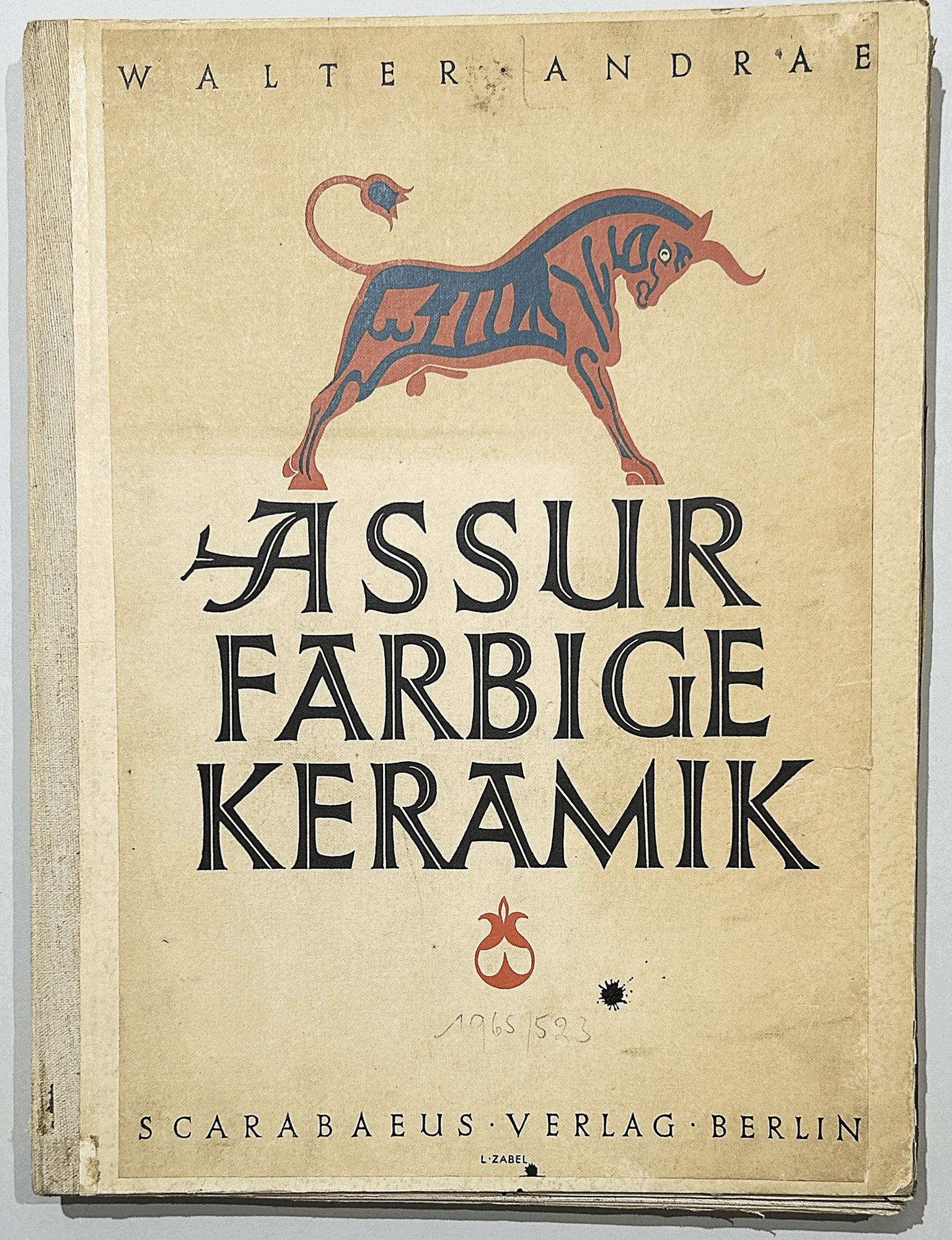 Glazed ceramic, 42 cm high and 22 kg, Neo-Assyrian, 8th–7th century BC. This one might be my favourite. My paternal family is Assyrian, so it's nice to imagine auntie made this. In one of the plugin's red-weighted modes a frieze shows up: triangles at the rim, rosettes with a striding animal between them, and a band of rosettes below. The photograph shows faint orange bands and turquoise flecks. This vessel's bull looks exactly like the one on the cover of Walter Andrae's Farbige Keramik aus Assur (1923), painted orange with blue markings. In it he recorded, in colour, the glazed pottery from his excavations there as it came out of the ground, before the glazes faded on exposure. I haven't been able to find a PDF copy, but my guess is this vessel is in there as it looked when it was dug up. Vorderasiatisches Museum, Berlin.